
Kearny Property Tax Record Fields
Two record sets make up Kearny County property tax records. The Appraiser discovers, lists, classifies, and values property. The Treasurer bills and collects the tax, tracks delinquency, and handles the real-estate tax-sale path, so any complete check keeps those roles separate.
| Field | What It Shows | Where |
|---|---|---|
| Appraised value | Fair-market conclusion as of the annual valuation date, except special methods such as agricultural use value | Kearny County Appraiser |
| Assessed value | Class percentage applied to appraised or use value | Kearny County Appraiser |
| Classification or exemption | Legal treatment affecting the taxable base | Appraiser and, for exemption applications, BOTA |
| Tax statement and status | Amount billed, installments, payments, and delinquency | Kearny County Treasurer |
| Mill levies | Rates of the state and local taxing units applied to assessed value | Tax statement and county records |
Assessed value is not a sale price. Kansas applies a class rate to the appraised value, or to statutory use value, and mill levies then hit the assessed amount. Recorded consideration belongs elsewhere. That figure sits in the deed transfer record and its validation paperwork, not the appraisal roll.
Kearny Assessment Rates
The Kansas property-tax basics page illustrates the formula. Residential real property is assessed at 11.5 percent, and vacant lots sit at 12 percent. The statutory table adds 25 percent for commercial and industrial real property. It sets 33 percent for public utility real property. Agricultural land is assessed at 30 percent of its use or productivity value.
| Residential real property | 11.5% |
|---|---|
| Vacant lots | 12% |
| Commercial and industrial | 25% |
| Agricultural land | 30% of use or productivity value |
| Public utility real property | 33% |
The class matters as much as the number. Verify the classification on the Kearny record before estimating an assessed value.
Kearny 2026 Market Study
The Kearny County Appraiser's 2026 notice drew on arm's-length sales from 2021 through 2025. Residential, vacant-lot, and commercial studies used that window. The county described its market as relatively stable, with slight upward movement in some neighborhoods. Agricultural values moved the other way. Dry-crop and irrigated land both saw slight decreases. Those are county-level findings, not a promised change for every parcel. Change-of-Value Notices carry the January 1, 2026 appraised value and were mailed March 1, 2026 or later, and the notice itself states plainly that it is not a tax bill. The county's market-study notice displays them.
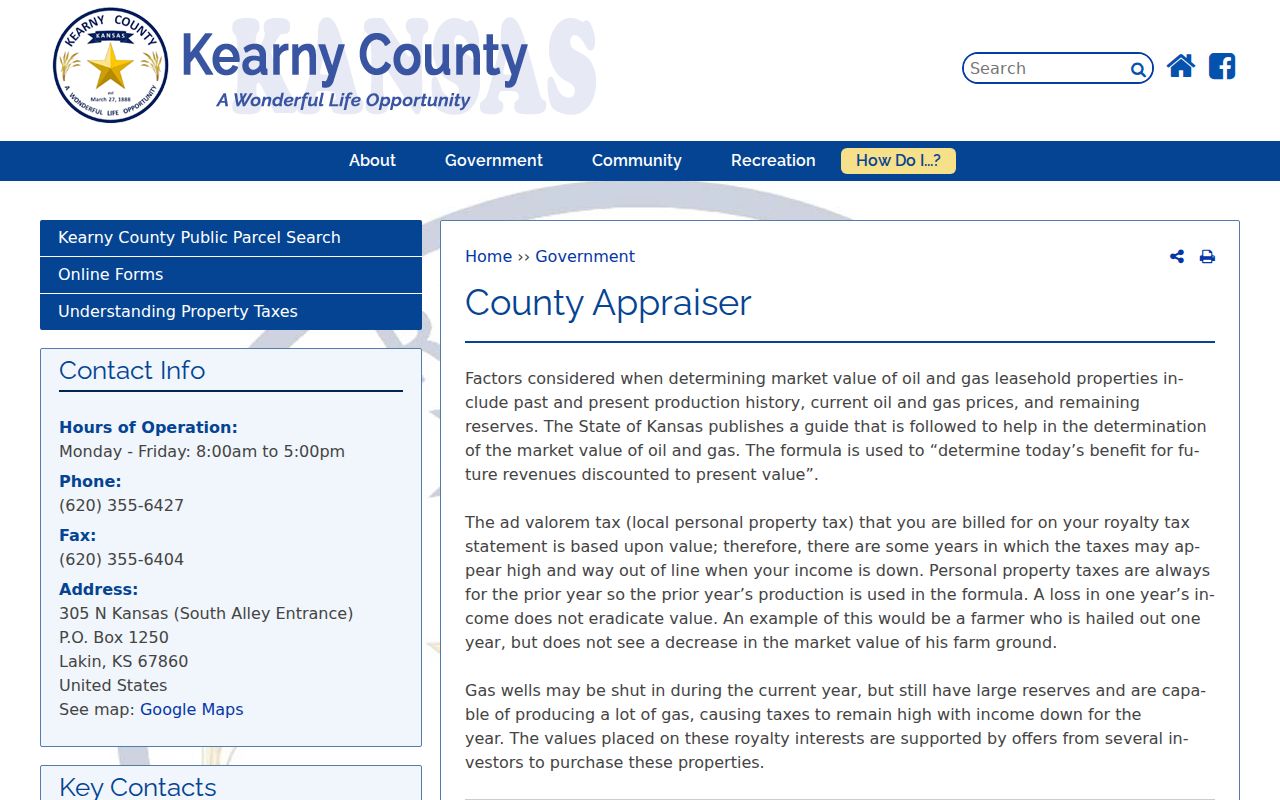
The notice is a countywide valuation summary. Read it that way, not as an individual statement or current balance.
Look Up Kearny Tax Statements
Start at the official Kansas property-tax portal and pick Kearny County from the required selector. Kearny posts a notice there. The county does not accept late payments online. That limit affects only the payment route. It does not affect the records themselves. Statements and delinquency information still exist; you simply pay past-due amounts another way. Call the Treasurer at 620-355-6372 for the current Kearny procedure on delinquent tax bills.
- Start with the Kearny county selector and follow the available statement route.
- Match the parcel lead, owner, legal description, and tax year.
- Separate the appraised and assessed values from the amount billed.
- Confirm payment, delinquency, interest, and sale status directly with the Treasurer.
- Assessed value
- The class-adjusted base to which tax levies are applied.
- Mill levy
- A rate measured per thousand dollars of assessed value.
- Property exemption
- A legal exclusion from valuation or taxation that requires a supported category and process.
- Tax lien
- The public claim arising from unpaid property tax.
The portal's Kearny result is visible in the official capture linked above.
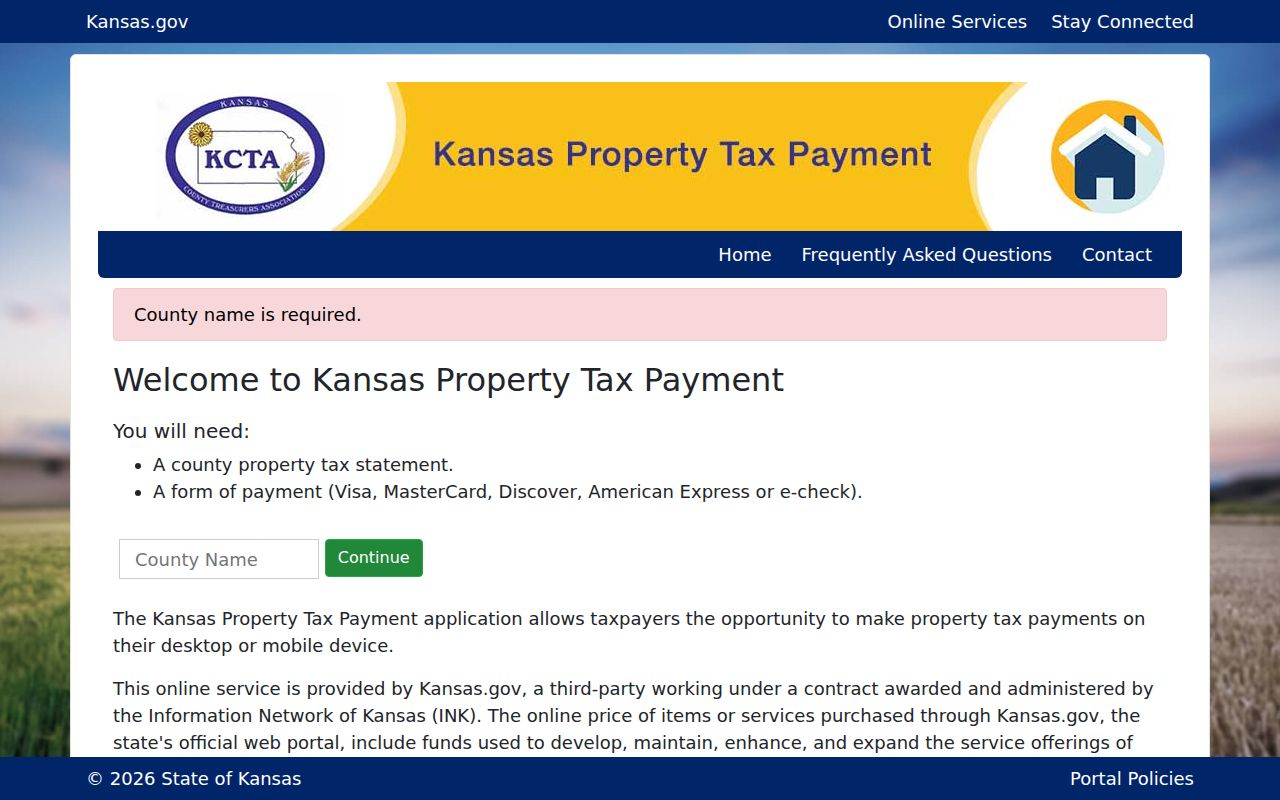
The portal's notice covers late online payments only, so ask the Treasurer for current instructions before paying any past-due amount on a parcel.
Kearny Tax Due Dates
Kearny County's Treasurer sets December 20 and May 10 as the main real-estate tax deadlines. They apply each year. Miss the personal-property deadline and delinquent warrants may issue after publication. Real estate travels a longer path. The county publishes delinquencies. It follows a three-year rule before a parcel can reach tax sale. A late-payment message online tells you nothing about a pending sale. Ask instead for the parcel's actual tax years. Ask also about its publication status, redemption details, and the current balance. Tax-sale lists change often. Check with the Treasurer for the latest one. Note: Payment status and ownership are separate, so confirm the current grantee with the Register of Deeds when title matters.
Kearny Property Exemptions
Kearny County's own property-tax materials point to churches, farm grain storage, and certain taxing entities. These are examples that may qualify under exemption law. A nonprofit label alone proves nothing. Neither does an owner's name. The Kansas Board of Tax Appeals PVX form requires the applicant, owner, representative, parcel ID, county, tax years, and property address. It also requires use details and a signed certification. The official PVX application shows every evidence field in detail. Confirm filing steps and eligibility with the Appraiser or BOTA before submitting. Exemption is a legal classification, not a courtesy discount.
Kearny Payment Under Protest
Kansas allows payment under protest only in stated circumstances. December 20 is the standard deadline. Escrow works differently. An escrow or tax-service agent has until January 31 instead. One caution applies. The state publication warns against combining payment under protest with a valuation appeal for the same property and tax year when that overlapping route was already pursued.
That appeal challenges value, classification, or exemption, but it cannot correct recorded title or stop a delinquency or sale deadline, so contact the Appraiser and Treasurer before choosing a path.
Appeal a Kearny Assessment
A taxpayer has 30 days after the value notice is mailed to request the informal or equalization appeal. Start by asking the Appraiser. Request the valuation information used. The state calendar then moves quickly. It targets May 15 for the informal meeting, May 20 for the determination, June 1 for appraiser certification, and July 15 for the clerk's abstract certification.
The Kansas Board of Tax Appeals comes next. That further appeal is generally due within 30 days after the final determination, and comparable sales, property-condition evidence, classification facts, and exemption proof can all carry weight. An owner-name or deed dispute belongs with the recorded chain of title, not in a valuation appeal.
Appeal window. The first Kearny valuation appeal must be requested within 30 days of the notice mailing. Preserve the envelope and notice date.
The Kansas Department of Revenue appeal page is shown in the captured official screen.
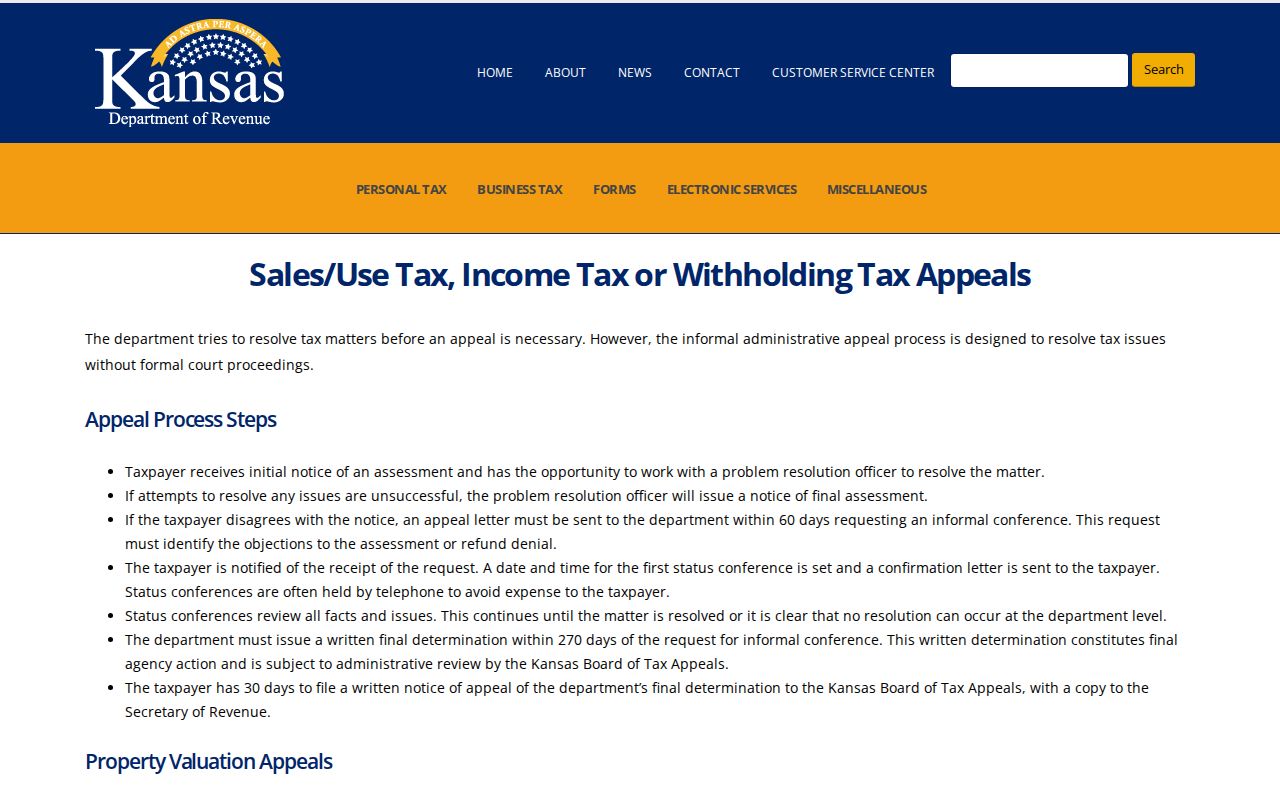
The appeal sequence follows state guidance. Parcel-specific evidence and the notice date come from the Kearny Appraiser. Use the Kearny County property value explanation instead.
Kearny Tax Access Fallbacks
Phone and mail still work when a browser will not. The Treasurer takes questions at 620-355-6372 or by mail at P.O. Box 146, Lakin, KS 67860. Ask about the current statement, paid status, delinquent years, interest, and publication status. Also ask about any tax-sale step tied to an identified parcel. Call ahead to confirm counter hours before making the trip.
For value, class, and assessment details, the Appraiser is the right office at 620-355-6427. Give both offices the same parcel lead and legal description. That way nothing gets lost between them. When a routine route will not surface an existing public record, a narrow KORA request can name the record, year, and parcel. It can also name the format you need. Expect reasonable actual costs and possible advance payment.
Timing matters here. A tax record can lag a recorded ownership change. A deed record will not show whether taxes were later paid. Keep the office, date, and tax year beside every answer. That small audit trail makes a later update far easier to verify.
Kearny Delinquency Record Trail
Unpaid real-estate tax in Kearny County moves through a public process. It does not become an instant deed transfer. County materials set out due dates, delinquency publication, and a three-year real-estate tax-sale rule. Ask the Treasurer where notices are published, which tax years remain unpaid, whether redemption is still available, and what event has actually occurred.
A publication, a tax lien, a scheduled sale, a completed sale, and a recorded tax deed are different stages, and court filings can add another layer. An old notice alone never means sold. Confirm the current Treasurer record first. The Register of Deeds records any resulting instrument. Personal-property warrants follow a separate lane from real-estate tax. Keep record type and parcel identity clear. Kearny County publishes no current tax-sale roster, so present status must come from the custodian.
Kearny Value Evidence
A Kearny County appeal succeeds on evidence that fits the issue under review. Request the Appraiser's valuation information first. Verify the physical facts on the parcel record. Errors in classification, condition, land use, or comparable sales are the usual targets. Photographs, repair facts, measurements, and arm's-length sales can all help. They must relate to the valuation date.
A title dispute runs on a different track. If the owner of record or legal description looks wrong, notify the Appraiser, then verify the instrument with the Register of Deeds. Tax payment disputes belong with the Treasurer. Good routing protects the 30-day notice appeal window. Single-family and qualifying smaller non-agricultural matters may use BOTA small-claims procedures, though eligibility should be confirmed against the current forms rather than assumed from the parcel's value.
Kearny Tax Record Cross-Checks
Read every Kearny County property tax record with care. Check it against its tax year, parcel lead, legal description, and property class. An owner name alone can point to several parcels. A street address can change on rural land. It can fail there too. The legal description is the sounder bridge. It links the appraisal roll, the Treasurer statement, and the recorded deed.
Compare the appraised figure to the assessed figure with the correct Kansas class rate. Keep mill levies and the final billed amount separate. An exemption or a special agricultural method may affect the calculation. If the arithmetic still differs, ask both offices. The Appraiser can confirm which value and class were certified. The Treasurer can show which levies and credits appear on the statement.
Past years need extra care. Never mix a current card with an older bill. Request that year's archived valuation and statement. A later replat, split, combination, exemption, or ownership change can make today's card look different. Save the office response. Note the access date too. The whole comparison can then be repeated later.