
The Kearny County Owner-of-Record Card
A parcel card in the Kearny County system can display a small set of owner fields. The exact label and layout vary by result. Treat any list of expected fields as a checklist, and publish only the values the card actually shows for the parcel at hand.
| Owner name | Current-roll name, if the Kearny result displays it |
|---|---|
| Mailing address | Destination for appraisal or tax correspondence |
| Situs address | Physical parcel location |
| Parcel/account ID | Administrative key; exact Kearny format is unverified |
| Legal description | Lot/block/subdivision or section-township-range identity |
| Deed or sale reference | Capture only if visibly supplied on the live card |
Keep one caution in mind. The owner of record is not necessarily the occupant, and a mailing address is a contact clue rather than proof anyone lives at the situs.
The January 1 Kearny Roll and Recent Sales
Kansas appraisal practice values property as of January 1, while Kearny's 2026 valuation notices were mailed March 1 or later. That calendar does not establish a live owner refresh schedule. If a transaction just closed, the roll may temporarily retain the prior owner's name even though the deed has been recorded.
Open the Kearny County Appraiser page for the official office route shown below.
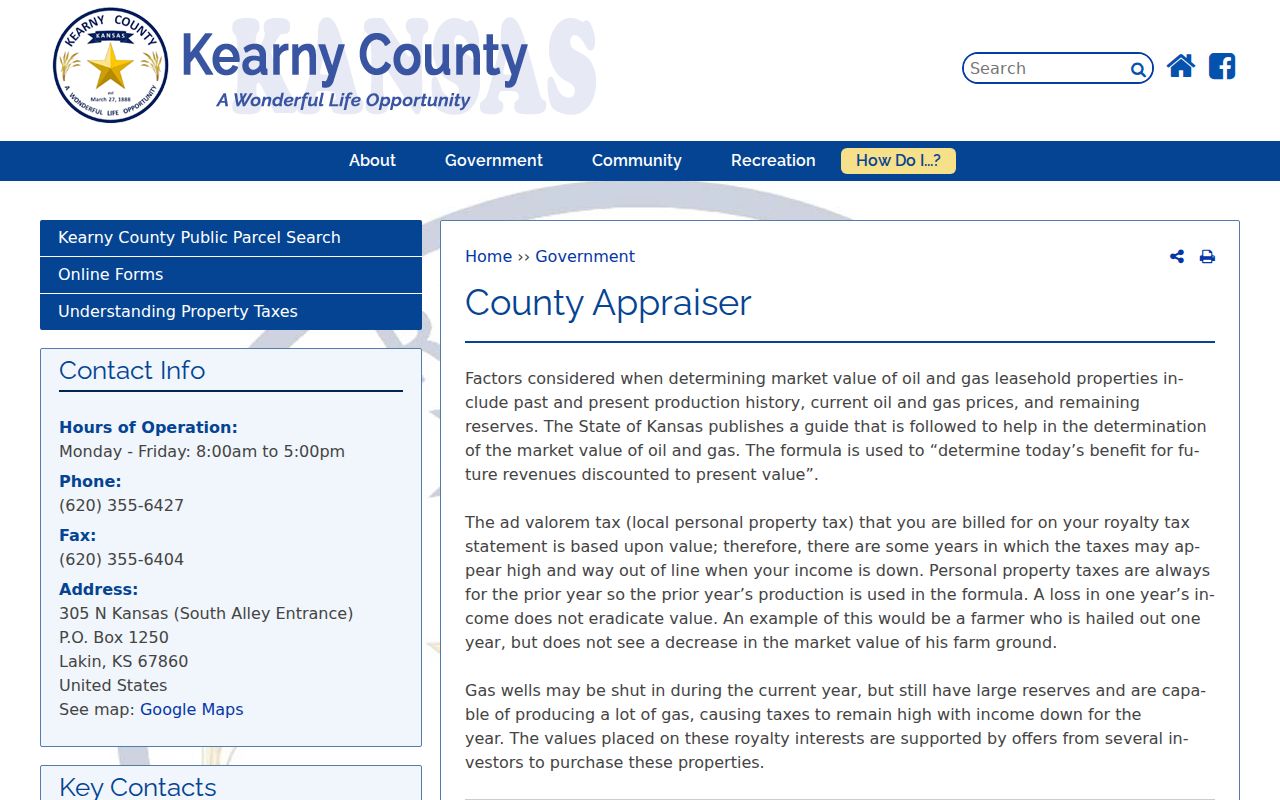
The Appraiser page confirms the access point, not the unpublished refresh interval or any particular parcel's current owner.
Mailing Address Is Not the Kearny Situs
The situs locates the parcel; the mailing address directs notices. A Kearny County owner may get mail at a PO box. Others use an address outside the county. Rural land may lack a conventional street number entirely. Confirm the city or rural location with the map and legal description rather than the mailing line.
Confirm the Current Kearny County Owner
Match the current-roll lead to the latest recorded conveyance, using the legal description rather than a name alone.
- Open Kearny ORKA, find the situs, and copy the visible roll name and legal description.
- Call the Register of Deeds at 620-355-6241 for the newest deed matching that description.
- Read the grantee and the reception day, hour, and minute.
- For an entity, cross-check its exact name through the Kansas SOS search without equating its agent with ownership.
- Owner of record
- The party named on the relevant public roll.
- Recording lag
- The interval before a newly recorded change appears in another county system; Kearny has not published its interval.
- Registered agent
- A business contact, not automatic proof of land ownership.
Current Kearny Owners Can Be Entities or Estates
A Kearny County roll can name an individual, an LLC, a corporation, a trust or trustee, an estate, or a personal representative. A deed can name them too. Search exact and variant spellings, then compare legal descriptions. The Kansas business search can clarify an entity's formal name and agent. Trusts may return no ordinary entity result. Probate authority may surface in a court record or a deed record instead.
Call the Appraiser, Then the Recorder
For a current-roll question, contact the Kearny County Appraiser at 305 N Kansas, South Alley Entrance, Lakin, or 620-355-6427. For the newest recorded grantee, call the Register of Deeds at 620-355-6241 or write to P.O. Box 42, Lakin, KS 67860. The county publishes no online deed index. Counter, phone, and mail access remain essential. A narrow request under the Kansas Open Records Act may seek an existing parcel-card or index record. Identify the situs, legal description, and date range. Reasonable actual costs may apply.
Audit the Kearny Current-Owner Match
Do not stop at a matching name. Compare the physical address, parcel or account identifier, legal description, property class, and map location. Not every card shows a sale date, consideration, value history, or deed reference. Confirm a field is really present before treating it as a cross-check. A rural Kearny County parcel may be known mainly through section, township, range, quarter divisions, and acreage. A Lakin or Deerfield parcel may instead use a lot, block, and named subdivision or addition. When the roll and deed phrase the description differently, inspect plats, splits, replats, vacations, and stated exceptions. Do this before concluding the records concern different land. Which date controls? January 1 is the Kansas valuation date. It is not a promise that an owner name was updated that day or continuously afterward. The Register of Deeds' reception endorsement orders recorded instruments. For a present-owner verification after a recent closing, ask for the newest reception affecting the matching description.
Every Access Route for the Current Kearny Owner
| Channel | Best request | Limit to remember |
|---|---|---|
| ORKA online | Map, address, parcel and visible roll attributes | County detail varies and the owner label was not captured |
| Appraiser phone/counter | Existing parcel card and current-roll explanation | Confirm hours and copy costs |
| Recorder phone/mail/counter | Newest deed by legal description and grantee | No verified Kearny self-service index |
| KORA request | Narrow request for an existing card or index record | Exceptions and reasonable actual costs may apply |
| Library or museum | Old directories, maps, newspapers, name variants | Historical clue, not present title proof |
Use history sources only to resolve a name or location ambiguity. Then return to the current roll and the newest recorded conveyance for the Kearny County answer.
Resolve Common Kearny Current-Owner Conflicts
Conflicting names between ORKA and a deed usually have a simple cause. First confirm both records describe the same land. A newer deed often explains the difference. Weigh its reception timestamp against the roll's valuation context. When two deeds sit close together, request both instruments rather than trusting a search-result order or a sale-date field.
Copy the entity name exactly. Keep its punctuation and suffix intact. Search the Kansas SOS record by business name or ID. It clarifies entity identity and status, but not who owns the entity's land. A resident agent receives official communications, nothing more. For a trust, read the trustee capacity exactly; for an estate or representative, find the deed or court authority that touched the parcel.
When no conventional address resolves, fall back on the ORKA map, a parcel clue, or the rural rectangular-survey description. A PO box is only a mailing contact. A city name can mislead, too. Postal geography never decides whether the parcel sits inside Lakin or Deerfield. City limits and a call to the proper permit office settle jurisdiction questions.
Verification is not title assurance. The current owner of record works well for correspondence and preliminary due diligence. It will not reveal every unrecorded claim. Nor will it settle competing legal interests or guarantee that a signer can convey marketable title. A transaction needs the recorded chain and appropriate professional examination.
Rank Kearny Current-Owner Evidence
The strongest present-tense sequence starts with the newest accepted conveyance that matches the land. Its grantee and legal description establish the recorded transfer. From there, compare the Appraiser's owner-of-record lead, parcel identity, situs, and mailing fields, letting the map confirm geography. Business and court records explain capacity. They never displace the recorded instrument itself.
Not every clue proves ownership. A tax payment does not show that the payer owns the parcel, and a mailing address does not prove residence. An ORKA annotation is not automatically an owner field. An address point is not a parcel polygon. A resident agent may be neither member nor landowner.
For joint owners, copy each party and the conjunction precisely. For a company, copy the suffix. For a trustee, include the capacity wording and any recorded trust name. For an estate, identify the representative capacity and its connecting authority. These details matter when the same person's name appears elsewhere.
Some deeds point to other records. If the instrument references a plat, a prior instrument, a court case, or a probate proceeding, obtain that record before calling the owner clear. Do the same with exceptions. A fractional interest is not the whole parcel. The owner card is only a lead, organizing fields without proving title.
Dates anchor the result, since roll information, map publication, and deed reception each follow different schedules. A dated note should state which ORKA fields were visible, which office supplied the deed citation, and whether any gap remained between closing, recording, and roll display.
Record the Current Kearny Owner Result Precisely
A good note names the parcel before the person. Start with the situs, a confirmed parcel key, and the complete legal description. Then transcribe the roll name, mailing address, tax or valuation year, and any visible deed or sale reference. Fields missing from the live result get marked unavailable. Guesses stay out.
On the recorder side, capture the newest grantee, grantor, deed type, book/page or instrument number, reception timestamp, and exact description. Preserve multiple tracts or exceptions. Keep capacity wording for any trustee, representative, or company. That wording explains why a personal-name search may miss the record.
Close with a short comparison. Note whether the owner names match, whether the deed is newer than the valuation context, and which point stays unresolved. Descriptions deserve equal care. If the deed and map disagree, request the relevant plat or correction. A prior name on the roll is not an automatic error, so ask the Appraiser about timing first.
This structure beats copying a single name. It shows how the identity was obtained and what it does not prove. It supports purchase diligence, estate work, boundary communication, or a record correction. Verification is not a title opinion.
Use Kearny Owner Information Lawfully
Use any public mailing address from Kearny County property records only for a legitimate property matter. Kansas Safe at Home gives qualifying participants a substitute address, and confidentiality rules can limit what a recorder or assessor discloses. Access to ownership records never authorizes invasive contact.
Current-roll caution. The Kearny roll can trail a recent closing; the newest recorded deed is the stronger current recorded-owner source.