
Build a Kearny County Deed Chain Backward
Keep one row for every conveyance you confirm, and carry the complete legal description forward through each row. Treat the table as a worksheet, not a claim about any particular parcel.
| Transfer date | Grantor to grantee | Deed type | Book/page or instrument |
|---|---|---|---|
| Newest first | Prior owner to current grantee | As indexed | Copy exact reference |
| Previous link | Earlier grantor to that prior owner | As indexed | Match legal description |
| Repeat | Earlier grantor to earlier grantee | As indexed | Note exceptions and plats |
| Patent era | United States to original patentee | Federal patent | Bridge through tract books |
The Register of Deeds is the starting point. Bring the current legal description and work backward from there. When the online trail runs dry, continue through physical or microfilmed deed books, and apply the Kansas State Archives land-record method for the federal-to-county bridge.
Match the Kearny Legal Description at Every Link
Names repeat and spellings drift. Street addresses change too. A town parcel may use lot, block, addition or subdivision, city, county, and state, while a rural tract runs on section, township, range, quarter divisions, acreage, and exceptions. Copy the whole description. Flag any replat, vacation, split, easement, or excluded tract as you go.
Kearny County subdivision rules require title material addressing restrictions, easements, encumbrances, financial interests, tax arrangements, covenants, and engineer certification. A recorded plat can therefore explain why a later description differs from an earlier deed.
Capture the Kearny Reception Timestamp
Register of Deeds testimony describes endorsing the reception day, hour, and minute. That detail helps order instruments recorded close together. Call 620-355-6241 or write P.O. Box 42, Lakin, KS 67860, and ask for the index entry and instrument reference that match the legal description.
Note: Reception order can matter when two Kearny instruments concern the same parcel within a short period.
Read Kearny Grantor and Grantee Directions
A grantee received an interest. A grantor conveyed it. To travel backward, first find the deed where the current owner of record is grantee, then turn that deed's grantor into your next grantee search.
- Find the current acquisition deed by legal description and current grantee.
- Record grantor, grantee, deed type, recording reference, and reception timestamp.
- Search the grantor as an earlier grantee and verify the same land description.
- Repeat until the available index ends, then request the corresponding deed books.
- Grantor / grantee
- The conveying and receiving parties named in an instrument.
- Chain of title
- The ordered sequence of recorded transfers affecting the land.
- Reverse index
- An index organized to locate conveyances by the receiving party.
- Legal description
- The lot/block or land-grid identity that survives address changes.
Bridge a Federal Patent to Kearny Deed Books
The Kansas Historical Society land-record guide connects federal tract books with patents. It also links them to later county deed records. For an early rural parcel, find the section-township-range. Locate the federal entry or patent next. Then follow county conveyances forward until they meet the backward chain.
View the state land-record guide for the federal-to-county method it lays out.
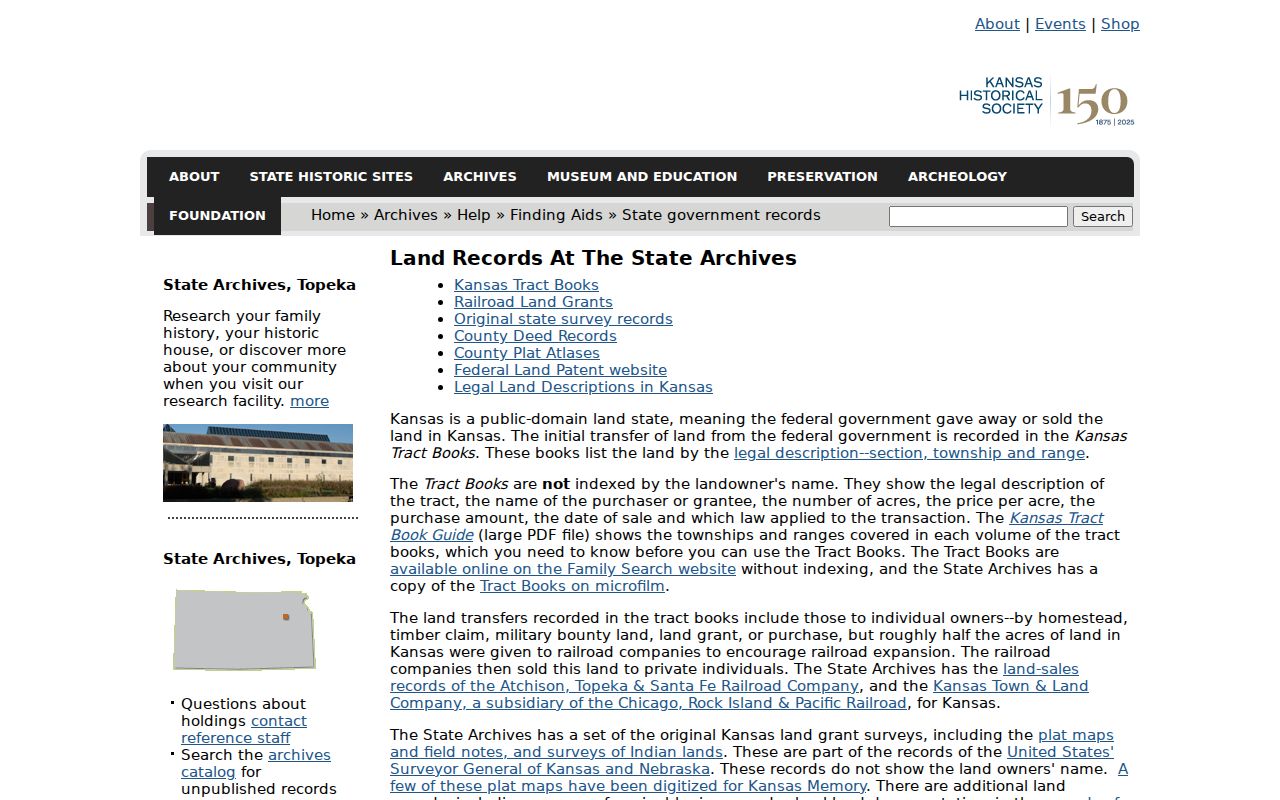
The guide supplies a method, not a Kearny deed index. It proves no owner's chain by itself. The 1887 atlas and a historical post-office index help reconcile older locations. They also cover the alternate “Kearney” spelling. Deerfield once sat in Finney County. An older notice may therefore require searching both counties and both place variants.
Probate and Quiet Title Can Repair a Broken Chain
A former owner can vanish from ordinary deed progression. Land may have passed through an estate, personal representative, decree, foreclosure, or quiet-title action. Use the Kansas District Court CaseSearch for permitted case information. For the authoritative file, ask the Kearny District Court clerk at 304 N Main, Lakin, 620-271-6254.
Vital records are not open ownership indexes. Kansas limits certified death records. Only people with qualifying status or a direct legal or property interest may obtain them. Start with probate and recorded transfer documents. Request vital evidence only when eligible.
Kearny History Collections Preserve Place Clues
The Kearny County History Collection holds Deerfield incorporation material, freighting records, the India Simmons reminiscence, and toll-bridge records. Museum people files, newspapers, directories, and microfilm can explain old owner or place variants. None of them replaces a recorded conveyance.
Kearny County has no known courthouse fire or blanket records loss. Treat a missing index entry as a search problem. Vary the names. Check the legal description, and search both direct and reverse indexes. Ask about reindexing or earlier books. Avoid declaring the chain lost.
Deed Types Change the Kearny History Reading
| Instrument | Historical clue | Next check |
|---|---|---|
| Warranty deed | Named conveyance with warranties expressed by the instrument | Read description, reservations, and prior reference |
| Quitclaim deed | Conveys whatever interest the grantor held | Do not infer a clean or complete title |
| Personal-representative or estate deed | Transfer following estate authority | Connect the probate file and recorded deed |
| Plat or replat | Changed lot or subdivision framework | Compare original and replacement descriptions |
| Patent | Federal transfer into private ownership | Bridge forward through county books |
A deed type names the instrument. It rarely covers every interest touching the land. Mortgages, releases, assignments, easements, liens, affidavits, restrictions, and court orders can explain gaps or burdens alongside the ownership sequence, so keep them in a related-instruments column separate from your owner rows.
Access Kearny Former-Owner Sources Offline
The Register of Deeds is the main custodian. Deeds, plats, easements, mortgages, releases, assignments, liens, and affidavits all live there. Each enters the records once accepted for recording. Ask whether that year is electronic, on microfilm, or in a physical book. Request the direct and reverse index entries, then the cited instrument. Confirm inspection hours, copy method, and charges before visiting.
If the parcel identity is shaky, call the Appraiser at 620-355-6427 for the current parcel. Ask for the legal-description lead too. Court-created transfers go through the Kearny District Court clerk. A focused KORA request can surface existing index or county records. It is subject to exceptions and reasonable actual costs. Libraries and museums hold directories, newspapers, atlases, and people files. These help generate spelling and geography variants.
Log every searched name, date span, index direction, and book or page number. Log the legal-description variation and every negative result too. A negative search proves little. It shows only a failed query. It does not prove a person never owned the parcel. Nor does it prove a historic record was destroyed.
Audit the Completed Kearny Ownership Timeline
Once the rows are assembled, read the Kearny County chain from the oldest deed forward. Normally each grantee resurfaces later as a grantor. Probate, name changes, entity shifts, and partial-interest transfers break that rhythm. When a break appears, resolve it with the actual instrument. Do not force names into a tidy sequence. Party names alone never tell the whole story. One owner may have bought adjacent tracts in separate deeds. The same owner may have conveyed only a piece, reserved a mineral interest, or replatted a block of lots. Compare acreage and exceptions line by line. Note which description language shifted. Note which plat governed the change, and whether the next deed carried the new wording forward.
Tax rolls and city directories can place a name at a parcel in a given year. They support the chain but cannot replace it. Newspaper notices often point toward probate, foreclosure, tax sales, or quiet-title suits. Court files explain judicial transfers. Every clue should end at a recorded deed, sheriff's deed, representative's deed, or similar instrument tied to the described land.
Finish with citations another person can reproduce. Include custodian, index direction, party spelling, date, deed type, book and page or instrument number, and the legal description. That audit trail separates documented Kearny County former owners from a list of names. A simple list of names comes from secondary property records.
Follow Kearny Ownership Around Broken Links
Suppose the expected grantor never shows up as an earlier grantee. Search name variants, initials, spouses, trustee capacities, and business-name punctuation. Try both direct and reverse index directions. Then ask whether the parcel itself changed. Look for a split, consolidation, vacation, replat, correction deed, or acreage exception.
Probate can park authority in an estate file long before a representative's deed appears. Foreclosure and quiet-title actions hide their decisive language in a court order. A later recorded instrument finishes the story. Kansas CaseSearch provides permitted public case information. The Kearny District Court clerk holds the courthouse file and copies. Keep the case number and parties as leads.
Historic tax rolls, directories, maps, and newspapers can narrow an era. They belong beside the deed chain, not inside it. Maintain a parallel evidence list recording what each source said. Note which recorded deed it pointed to. The distinction matters whenever occupancy, tax responsibility, and ownership diverged in Kearny County.
Early rural land demands a careful read of the legal grid. Section, township, range, quarter divisions, acreage, and exceptions let you connect federal tract-book or patent material to a later Kearny deed. For town lots, use the addition or subdivision name with lot and block. Treat the historical "Kearney" spelling purely as a catalog or index variant.
If the chain stalls, say exactly where. List the last verified owner, deed citation, description, years, and index directions checked. Add the unverified next lead. That honesty beats declaring the chain complete or claiming records vanished. The Kearny courthouse suffered no verified fire loss. No office published an online cutoff for its property records.
Document Kearny Former Owners as Evidence, Not Lore
For every previous owner, cite the instrument connecting that person or entity to the parcel. Park oral history, museum files, atlases, tax rolls, and newspapers in a separate notes column until each one leads to an authoritative record. Such sources add human and geographic color. They cannot establish a conveyance on their own. Flag uncertain name readings, incomplete descriptions, and unavailable books. Note which office or archive was contacted, and when. Where the oldest verified county deed bridges to a federal patent, cite both sides. If the sequence stops earlier, report the gap plainly rather than inventing an owner or cutoff year.
A finished backward chain should run in reverse too. A reader ought to start at the oldest row and follow each grantee forward into the next conveyance. That simple check catches skipped interests, partial tracts, and party-name slips while keeping the Kearny County property history transparent.
Kearny County's Online Cutoff Is Unpublished
The Kearny County Register of Deeds publishes no online grantor-grantee portal. It also gives no stated beginning year for electronic property records. That gap should not become a guessed date or a claim that older records vanished. Ask the office directly which years are indexed electronically. Ask also which years still live in deed books or microfilm. State land-record guides and local history collections can then fill in older leads about the county's deed records.
Unknown cutoff. The online beginning year was not published. Earlier Kearny County owners may remain in deed books, microfilm, federal land records, and archives.