
How to Identify a Kearny County Property Owner
The county's Public Parcel Search runs through ORKA, so start there for a quick parcel and owner lead. For recorded confirmation, turn next to the Kearny County Register of Deeds, keeping the legal description handy at every step.
- Normalize the situs address or locate the rural tract on the map.
- Use Kearny ORKA and record only an owner field actually displayed.
- Save the parcel identifier and full legal description.
- Ask the Register of Deeds for the latest conveyance and read the grantee and reception timestamp.
Use the Kearny Situs as the First Clue
A situs is where the property physically sits. The mailing address is different. It shows where the assessor sends tax notices, which may not match the parcel location at all. Try full and abbreviated street types. PO boxes, rural routes, and vacant tracts call for the parcel map and legal-grid description instead, though Lakin ZIP 67860 and Deerfield ZIP 67838 can still narrow a Kearny County property search without setting city limits.
Note: A legal description is the dependable bridge when Kearny County address spelling differs across records.
When a New Kearny Deed Has Not Reached the Roll
Kansas values property on a January 1 basis, and Kearny County publishes no set deed-to-roll refresh interval. Because of that gap, a recently closed sale can still show the prior owner of record on the tax roll. The fix is simple. Ask the Register of Deeds at 620-355-6241 for the newest instrument and its reception day, hour, and minute. Then match the deed's legal description to the parcel number before drawing any conclusion about who owns it.
The Kearny County Appraiser, at 305 N Kansas in Lakin and 620-355-6427, is the office to call for roll questions. Its official page describes the human route to take when an online parcel result does not load.
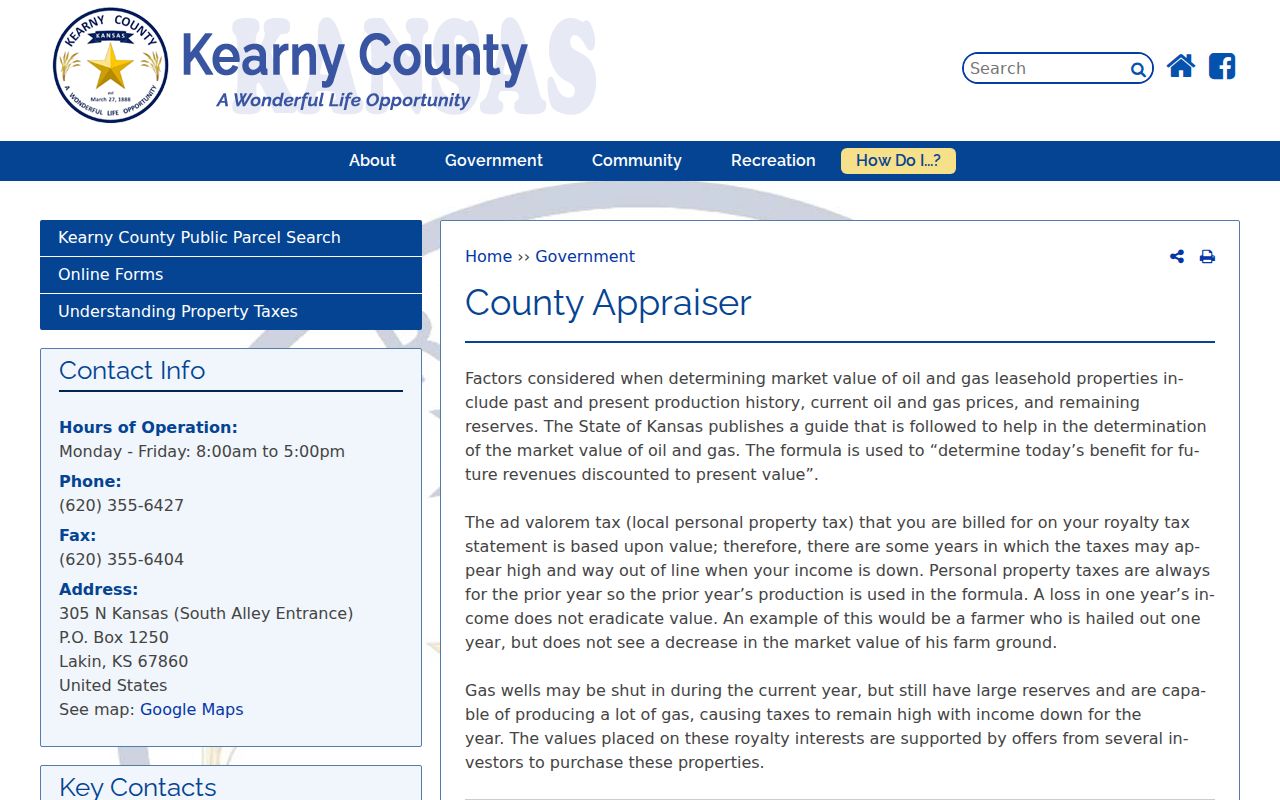
The office page is an access point rather than a parcel card. It will not verify any particular owner field.
Where Kearny County Ownership Clues Live
Each public source answers a different ownership question. The tax roll gives a convenient current lead, the deed records prove a transfer, and the parcel map ties an address to real geography.
| Source | Owner Info It Gives | Access |
|---|---|---|
| Appraiser roll / ORKA | Owner, situs, mailing, and parcel clues when displayed | Annual valuation context; refresh lag unpublished |
| Register of Deeds | Latest recorded grantee and legal description | Phone, mail, or counter request |
| Kansas SOS | Entity name, status, and resident-agent record | Online cross-check, not proof the agent owns land |
| GIS parcel viewer | Mapped parcel context and reports where available | Reference layer, not title proof |
The occupant of a property is not always its owner. The owner of record may be an LLC, a trust, an estate, a trustee, or a personal representative, with a mailing address somewhere else entirely.
Read LLC, Trust, and Estate Owner Names Carefully
Search any owner name exactly as recorded. Then try punctuation, suffix, trustee, estate, and personal-representative variants. The Kansas Business Entity Search can confirm a Kansas entity and its resident agent, though an agent is never the landowner by that fact alone. A trust may return no normal entity result, and estate authority may surface only in probate or the transfer instrument itself.
Ask Kearny County When the Portal Is Down
When the portal is down, call. The Appraiser handles roll fields. The Register of Deeds holds the recorded chain. The Treasurer at 620-355-6372 covers tax status. Kearny County offers no self-service grantor-grantee portal. Counter, phone, and mail routes still matter. So confirm office hours and copy charges before traveling.
A precise Kansas Open Records Act request can help. It can seek an existing parcel card. It can also seek an instrument index entry. Name the situs, possible owner, legal description, record type, and date range. Agencies generally respond by the close of the third business day or explain a delay. Reasonable actual costs may apply.
Cross-Check a Kearny Property Owner Without Guessing
Compare more than a surname. Check spelling, initials, co-owners, mailing address, and the legal description before trusting a match. Common surnames pull in unrelated parcels. Match an entity by its exact deed styling and its Kansas SOS identification number when one appears. For a trust, keep the trustee's capacity language intact. For an estate, look for the personal representative and the instrument that transferred the land, since a probate filing alone is not the new deed.
Vacant land deserves extra care. A convincing name or map printout can anchor an attempted fraudulent sale. Compare the newest recorded grantee, the reception endorsement, the legal description, and the signer's authority. Use only published county numbers. Skip contact details from an unknown seller. A title professional can settle interests and exceptions that an owner lookup cannot.
What if ORKA shows no owner? A blank result can reflect county publication choices, incomplete statewide coverage, or a search mismatch. Ownerless land is not the answer. Save the address and mapped location, then ask the Appraiser for the parcel key and the Register of Deeds for the newest conveyance.
Kearny County Ownership Terms in Plain Language
- Owner of record
- The party named on the relevant assessment roll; useful as a present lead, but potentially behind a newly recorded transaction.
- Grantee
- The receiving party named in a recorded conveyance. The grantee in the newest matching deed is the key confirmation.
- Situs
- The property's physical location, distinct from the destination used for owner mail.
- Legal description
- The lot-and-block or section-township-range wording that identifies the land across offices.
- Title
- The legal ownership interest and its possible burdens. A public name lookup is not a professional title examination.
People-finder data is a weak ownership source. Such data can be stale. It can merge similar names or describe residence rather than title. Official Kearny County property records are the correct starting point, with each custodian consulted only for the record it maintains.
Apply the Kearny Owner-Finding Flow
For a Lakin town lot, start with the street address. Confirm the location on a map first. Write down any lot, block, subdivision, or addition wording. Then request the newest recorded deed matching that description. Deerfield follows the same property records hierarchy, with one wrinkle: older material may reference Finney County. Treat the historical county name as a search variant. Do not use it as a reason to bypass the modern Kearny custodian.
Rural acreage works differently. An ordinary address can be secondary out there. Lean on section, township, range, quarter divisions, acreage, and exceptions instead. The Kansas land-record method can trace an original federal patent through later Kearny County deeds. So the chain is reachable. The owner of record is whoever appears on the latest matching recorded transfer. The earlier sequence serves a former-owner reconstruction.
A vacant parcel listed for sale demands more than a caller's claimed identity. Compare the tax roll lead, the newest grantee, the exact legal description, reception details, and signing authority. Pull county contact information independently rather than trusting what a stranger supplies. A map printout or tax screen does not prove anything on its own. It does not show that anyone on the phone has authority to convey the land.
Sometimes the goal is simply lawful contact. The public mailing address on an available roll can serve that purpose. Never treat it as a residence or use it to intrude on anyone's privacy. Safe at Home and other confidentiality rules may substitute or withhold address information in Kearny County property records. Those rules may also withhold it entirely. Respecting that boundary is part of any sound property search.
Prepare a Kearny County Owner Request
Gather your clues before calling. Assemble the full situs, map location, parcel identifier if displayed, and complete legal description. Include possible owner spelling and an approximate transfer date. Tell the Appraiser whether you need the current roll name or a mailing address. Parcel identity is the other option. Tell the Register of Deeds plainly what you want. Ask for the newest recorded conveyance for the described land.
Ask the recorder for the indexed grantor and grantee and the deed type. Also request the recording or book-and-page reference, reception date and time, and legal description. If the answer points to another instrument or plat, follow that citation. Do not ask the office to decide legal title. Request the existing deed records and use appropriate professional help for the conclusion.
A written KORA request should stay narrow. Kansas agencies generally respond as soon as possible. They answer no later than the third business day's end. Otherwise they explain the delay. The law permits reasonable actual costs and possible advance payment. A precise Kearny County property records request is easier to locate. It is also far less likely to return unrelated names.
Use a Kearny Ownership Evidence Ladder
Start with location evidence. That means situs, map point, parcel polygon, and legal description. Next, gather the roll lead from the Appraiser or ORKA. Then obtain the newest recorded conveyance. Only after that should you investigate entity, probate, or court authority. Do so only when the recorded name or capacity makes it necessary. This order cuts false matches and keeps secondary sources from overruling county records.
Similar street addresses trip people up. The legal description and parcel identifier distinguish two Kearny County parcels that share a near-identical situs. Shared surnames are handled the same way, since the complete grantee styling and description separate their deeds. If a company changed its name, Kansas SOS records supply the formal entity history. But the land transfer itself still lives in the recorder's instruments.
A deed can convey less than the whole parcel or reserve an interest. Read the acreage, fractions, exceptions, and incorporated plat references first. Only then declare the grantee owner of everything shown on the map. An assessor polygon and a deed tract can diverge. The cause may require a plat, correction, or survey to resolve.
Probate can explain authority. Use the District Court record as a supporting source, then locate the recorded transfer that affected the land. Vital records stay restricted under Kansas law. They are not public ownership indexes, though eligibility and a direct legal or property interest may qualify someone for certified copies.
Aim for a reproducible result. On a stated date, a named roll field showed one party. The latest recorded deed for the matching legal description named a stated grantee at a particular reception time. If either element is missing, say which part is only a lead.
Note: Keep the date and custodian with the result so any reader can repeat the Kearny County ownership check.
Limits of a Kearny County Owner Lookup
A public name does not resolve everything. Unrecorded interests, competing claims, beneficial ownership behind a company or trust, and many title defects all escape a simple property search. Kansas Safe at Home participants may use a substitute address in covered public records. The exact Kearny parcel-card owner label and roll refresh interval remain unconfirmed. Do not guess at them.
Lawful use. Kearny County ownership records support due diligence, boundary questions, and estate research. Never use owner information to stalk, harass, threaten, or harm anyone.